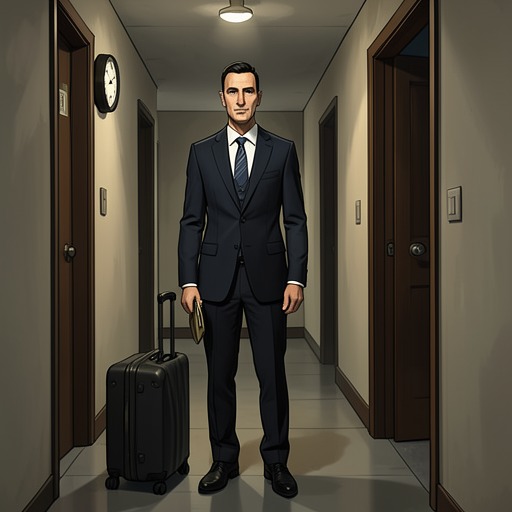
Daniel decides not to attend Yale
The Sun is Also a StarDaniel's decision to decline Yale is less a clean break from education than a refusal to treat the prestigious university as the only future available to him. First voiced amid uncertainty and pressure, the choice becomes concrete after high school: he leaves his parents' home, works two jobs, and attends Hunter College part-time, building a life whose direction is his own even as it remains entangled with his feelings for Natasha.
The Choice Takes Shape
In an office exchange, Daniel walks away from the prospect of continuing with the Yale interview and says that he does not really care about Yale. The person following him warns that Yale could open doors, drawing on his own experience of what attending had made possible. Daniel recognizes that the warning may be right and that he may be thinking too narrowly. The exchange leaves the decision unsettled: rejecting Yale is not presented as an easy or obviously wise answer, but as a choice made while its consequences are still unclear.
Later, with his parents calling repeatedly, Daniel anticipates that they will be angry when he gets home. He accepts that consequence. He imagines being somewhere else the following year, though he does not yet know where, and says he is unsure whether college is for him, at least not Yale and at least not yet. He allows for the possibility that he is making a mistake, but regards it as his mistake to make. That distinction gives the decision its force: uncertainty remains, while responsibility for choosing shifts to Daniel.
What He Chooses Instead
The later account establishes that Daniel does not attend Yale. After finishing high school, he moves out of his parents' house, takes two jobs, and enrolls at Hunter College part-time. He majors in English and writes poems described as small and sad. The outcome complicates any reading of his earlier refusal as a rejection of learning altogether. He continues his education, but through a less all-consuming and more practical arrangement, combining study with paid work.
His choice also changes the scale and texture of his early adulthood. Yale had been presented as a place that could open many doors; Daniel instead makes a life from work, part-time study, and writing. The narrative confirms this path through concrete actions rather than a declaration that the decision has solved anything. He has chosen a direction, but its emotional costs and uncertainties continue alongside it.
Natasha and the Years Apart
Daniel's decision unfolds against his separation from Natasha, though the account does not identify her as the cause of his declining Yale. Natasha enrolls in school in Kingston, where her class is called Sixth Form; she studies for Caribbean Advanced Proficiency Exams and A-levels while waitressing to help her family. She initially fakes a Jamaican accent until it becomes real, finds a circle of friends, and gradually comes to love the country where she was born.
The distance asks different adjustments of each of them. Natasha lets Daniel go because she cannot live in two worlds at once, with her heart in one place and her body in another. Daniel holds on for as long as he can, hearing in her changing accent the cadence of her slipping away. His later poems remain marked by that attachment: even poems that are not about Natasha are still, in some sense, about her. His path away from Yale therefore does not produce emotional closure; the account places his practical choices beside a continuing private grief.
Significance and Aftermath
The event's significance lies in the gap between a prestigious opportunity and the life Daniel actually builds. He does not follow the route that another person says opened doors for him, but neither does he abandon college or work toward a single romantic alternative. His decision leads instead to Hunter College, two jobs, and an English major, while the uncertainty he voiced about whether college was right for him gives way to a more particular, part-time course of study.
The narration preserves the choice's unresolved quality. Daniel acknowledges that he might be wrong, yet does not make fear of error a reason to surrender the decision. In the years that follow, he accepts practical responsibilities and continues to write, while the separation from Natasha remains present in his work. Declining Yale is thus both a concrete educational choice and a step into a life defined by consequences he cannot fully predict.